If your home has a crawlspace, there's a good chance it's contributing to problems you can feel but can't explain — musty smells, cold floors in winter, higher than expected heating bills, allergy symptoms that don't quite go away. In many cases, the culprit is an unencapsulated crawlspace doing what unencapsulated crawlspaces do: pulling moisture, cold air, and airborne contaminants up into your living space.
Crawlspace encapsulation is the solution. But it's also one of the most misunderstood home improvement projects, mostly because it happens out of sight and involves materials and techniques that most homeowners have never thought about.
What "Encapsulation" Actually Means
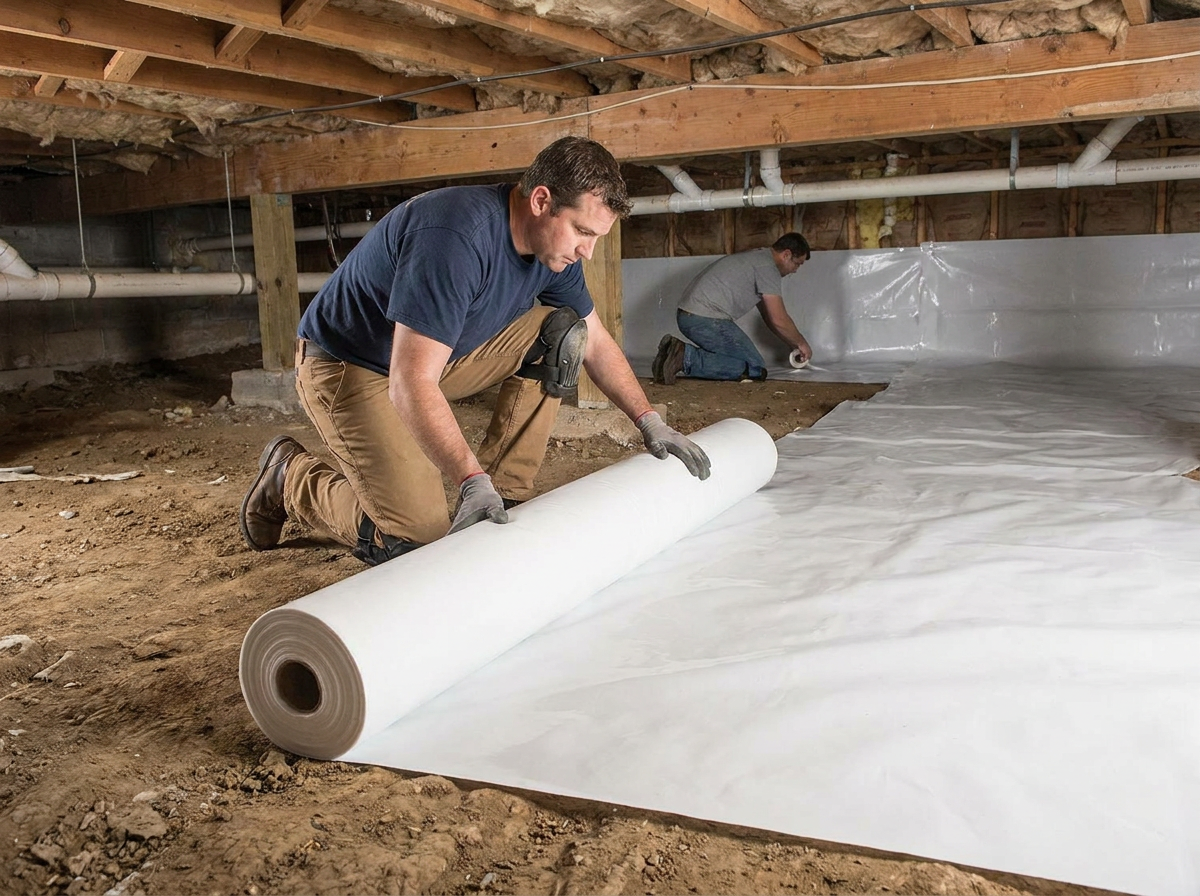
Encapsulation means sealing your crawlspace completely — floor, walls, and any openings — to create a controlled environment that's isolated from the ground and outside air. The core of the process is installing a heavy-duty vapor barrier across the entire crawlspace floor and up the walls, sealed at every seam and penetration.
This is different from the thin 6-mil poly sheeting you might have seen in older homes. Proper encapsulation uses a minimum of 20-mil reinforced barrier — the kind that won't tear when someone crawls across it, won't degrade from UV exposure if there are any light penetrations, and actually maintains a seal over time. We use American-made materials with a limited lifetime warranty against defects and taped seams.
Why an Unencapsulated Crawlspace Is a Problem
The "stack effect" explains most of it. Warm air rises inside your home and exits through the upper floors and attic. As it does, it creates negative pressure at the lowest point of the house — your crawlspace. That negative pressure draws air in from outside and up through the ground, carrying with it:
- Moisture from the soil (even in dry conditions, soil releases water vapor constantly)
- Radon gas (Western Massachusetts has some of the highest natural radon concentrations in the country)
- Mold spores from any mold growing on the wood framing
- Dust, allergens, and airborne particles
- Cold air that makes your floors uncomfortable and your heating system work harder
Studies suggest that up to 40% of the air in your home's first floor comes from the crawlspace. What's in your crawlspace is in your air.
Signs You May Need Encapsulation
- Musty or earthy smell anywhere in the house, especially near the floors
- Visible condensation on pipes, framing, or HVAC equipment in the crawlspace
- Wood rot on floor joists or the sill plate
- Mold growth on any crawlspace surfaces
- Cold floors in winter despite adequate heating
- Higher-than-expected energy bills
- Allergy or respiratory symptoms that improve when you leave the house
What the Installation Process Looks Like
Every crawlspace is different, so a proper encapsulation starts with a site assessment — which we offer for free. We measure the space, inspect the existing conditions, check for standing water issues, assess the foundation walls, and determine what's needed.
A typical installation involves:
- Cleaning the crawlspace and removing any existing degraded materials
- Installing drainage if standing water is present (sometimes a sump pump is required)
- Laying and sealing the 20-mil vapor barrier across the entire floor
- Running the barrier up the foundation walls and securing it to the rim joist
- Sealing all penetrations — pipes, wires, columns
- Taping every seam to create a continuous, airtight envelope
In some cases, we also install a dehumidifier to actively manage humidity levels inside the encapsulated space. This is particularly valuable in older homes or those with higher moisture intrusion.
What It Costs
Crawlspace encapsulation pricing varies based on the size of the space, existing conditions, and what additional work is required. We don't publish a flat rate because a 400 sq ft crawlspace with a dry concrete floor is a fundamentally different job than a 1,200 sq ft space with standing water and wood rot.
What we do offer is a free assessment with a detailed, upfront quote — no hidden fees, no surprises after the work starts. We'll walk you through exactly what we're recommending and why.
The Long-Term Value
A properly encapsulated crawlspace improves indoor air quality, reduces moisture-related damage to your home's structure, lowers heating and cooling costs, and eliminates one of the primary pathways for radon entry. Our encapsulation work carries a limited lifetime warranty on defects and taped seams.
For a home in Western Massachusetts — with its damp springs, cold winters, and high radon geology — it's one of the most impactful investments you can make in your home's long-term health and your family's.